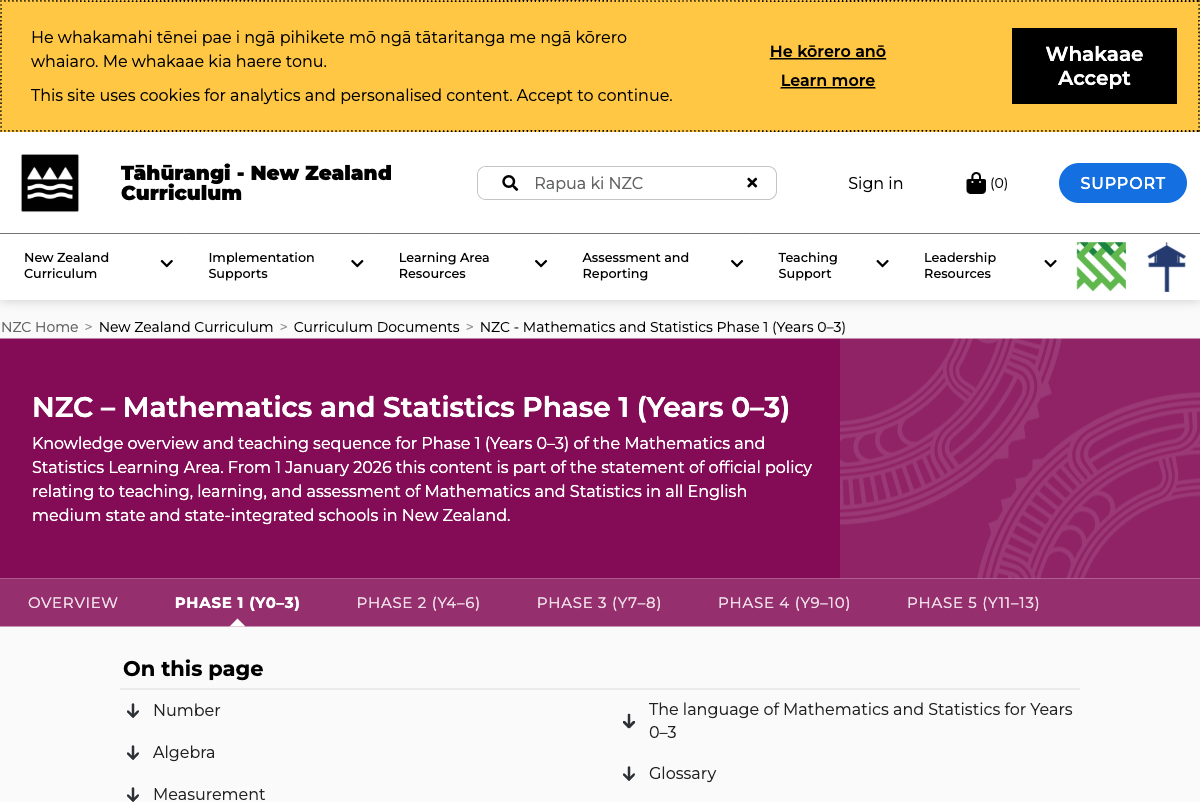
The curriculum page is accessible to read, but its meaning is trapped in page layout. We preserve the table structure and assign identifiers to the important rows, cells, and curriculum statements.
NZ Maths Assessment
New Zealand maths, ready to explore
Choose a path into the curriculum, try the first assessment, review a report, or look up learning words in the glossary.
3 x 4 = 12
1/2 + 1/2 = 1
100 - 37 = 63
Why This Exists
A parent-facing prototype for turning static curriculum documents into real-time, traceable assessment.
The Problem
Families need clearer, faster learning signals.
The curriculum expectations have shifted, but the assessment tools parents see have not kept pace. The result is feedback that can arrive half-yearly, at a very broad level, and in language that is hard to translate into next steps.
The report showed a broad level judgement, but it did not link that judgement back to the curriculum. There was no traceability or fidelity from the result to the curriculum statement, question, or evidence that would explain what the learner actually knew or needed next.
It can feel like being asked to judge how a cake tastes while the cake is still in the oven. You get a hint that something may need attention, but not the fine-grained information needed to know what to do next.
What the current assessment fails to tell you
Frequency
Feedback can arrive half-yearly, long after the learner has moved on.
Coherence
The language is broad and hard to connect back to specific curriculum expectations.
Fidelity
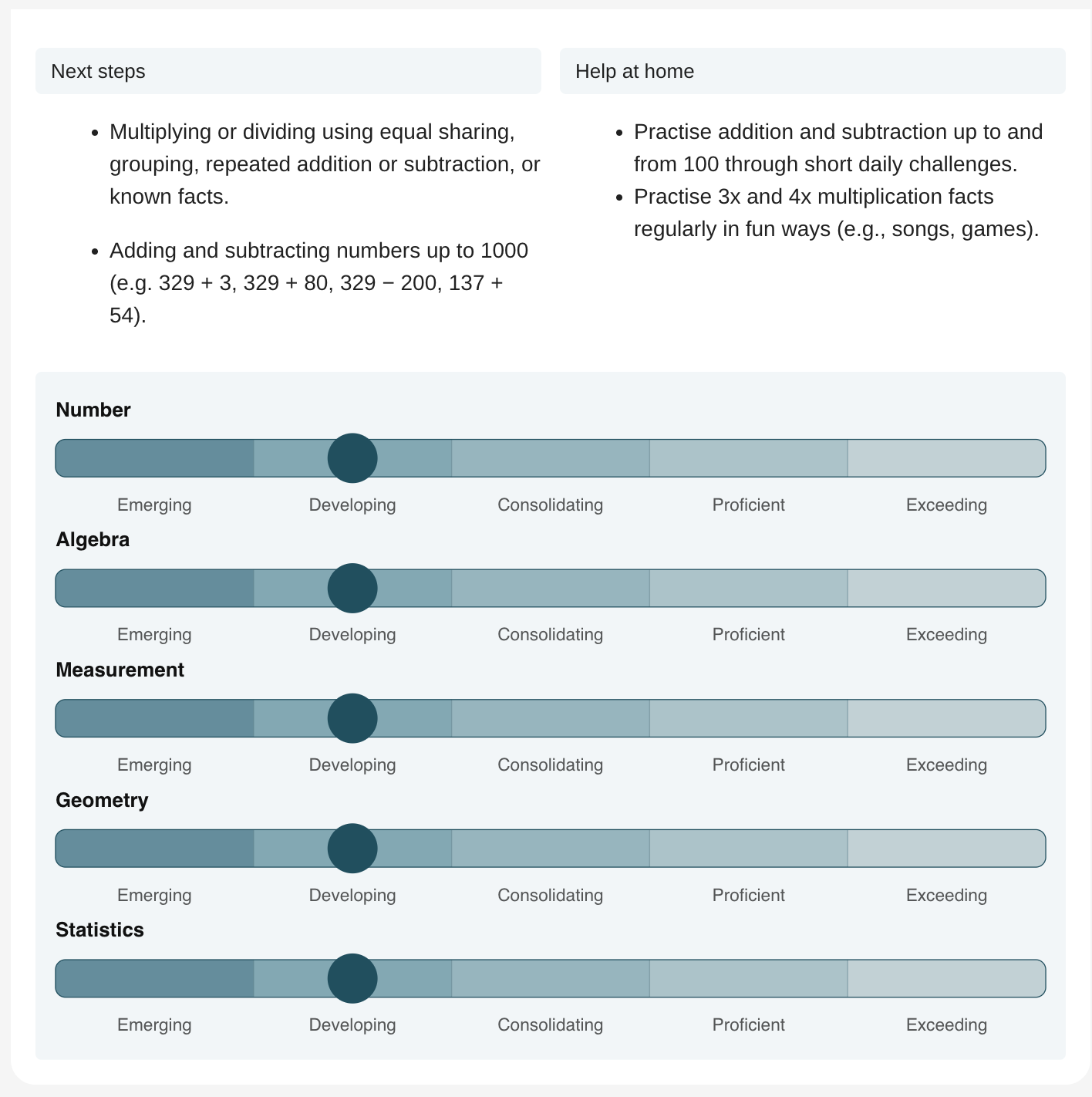
The signal is too low-resolution: developing in a whole strand does not show which ideas are secure or fragile.
Actionability
Parents are left without a clear next question, next concept, or next practice activity.
The counter-move
We took the curriculum itself, preserved its structure, gave each assessable curriculum statement a stable identifier, and used that living documentation as the base for a real-time assessment prototype.
This is an early prototype. It is not trying to replace teachers or formal assessment. It is trying to show that curriculum documents can become usable tools: more traceable, more frequent, and easier for families to understand.
What Is Living Documentation?
Living documentation turns a static curriculum page into structured source material that assessment tools can actually use.
Once every curriculum statement has an identifier, a question can say exactly what it is assessing. That turns a broad result into something you can trace back to the source curriculum.
The public page does not make it obvious when wording changes, disappears, or shifts meaning. A snapshot plus structured files gives the project a versioned record of what the assessment was built from.
Words can change meaning even when the page looks the same. A glossary makes the domain language explicit, so terms used by questions, reports, and curriculum statements stay understandable.
The practical idea
Living documentation is the bridge between a static curriculum document and a useful assessment experience: structured enough for software, traceable enough for trust, and readable enough for people.
FAQ
Short answers about what this prototype assesses, what it does not assess yet, and how to read the coverage.
How much of the curriculum does the current assessment cover?
The current assessment covers the curriculum broadly but shallowly. It has 27 questions, covers all 5 strands, and includes one question for each of the 27 curriculum rows/topics.
5 / 5
strands covered
27 / 27
curriculum rows covered
27
diagnostic questions
27 / 364
statements directly referenced
The important nuance is that this is a first diagnostic sweep. It touches every row of the Year 3 curriculum, but it does not deeply assess every curriculum statement yet. A full mastery bank would need many more questions and richer evidence for each statement.
Is this site private?
Yes. No assessment data is collected, uploaded, or stored by this prototype. The question bank, answers, scoring, and report all run in the local browser session.
If you refresh the page or leave the site, the current assessment state is not saved. A future version would need an explicit privacy model before storing learner profiles, assessment history, or parent/teacher accounts.
Docs
Rendered product requirements and assessment expansion plan for the living documentation prototype.
Loading requirements...
Suggestions
Send ideas, corrections, or requirements that should be added to this prototype.
Feedback
Any suggestions?
Send ideas, corrections, or requirements that should be added to this prototype.
Curriculum Overview
Source-backed cells and curriculum statements from the captured New Zealand Curriculum table.
Initial Assessment
One canned question per curriculum row, linked back to specific curriculum identifiers.
Assessment Report
Current scoring is correct answers out of total questions, with strand-level summaries.
Glossary
Initial domain glossary extracted from the curriculum and assessment language.